AI Weather Models Revolutionize Hurricane Forecasting Speed, But Physical Accuracy Remains a Challenge
Introduction
Artificial intelligence is rapidly transforming the field of weather prediction, offering forecasts that once required hours of supercomputing time to be completed in mere minutes. However, as AI tools assume an increasingly prominent role in high-stakes hazard modeling, researchers are raising essential questions about the reliability and physical accuracy of these systems.
A groundbreaking study by researchers at Rice University has provided the most comprehensive evaluation to date of how AI-based global weather models simulate tropical cyclones. The research, published in the Journal of Geophysical Research: Atmospheres, reveals both the remarkable potential and critical limitations of AI weather forecasting systems when it comes to predicting one of nature’s most destructive phenomena.
The Promise of AI in Weather Forecasting
Traditional numerical weather models have long been the backbone of meteorological forecasting. These systems simulate atmospheric processes by solving complex physical equations, a computationally expensive approach that requires significant processing time and computational resources. AI models represent a paradigm shift in this approach.
“In recent years, we’ve seen an explosion in AI-based weather models,” explains Dr. Avantika Gori, assistant professor of civil and environmental engineering at Rice University and corresponding author of the study. “These systems are trained on massive atmospheric datasets, and once trained, they can generate global forecasts in just a minute or two, which is dramatically faster than traditional physics-based models.”
This speed improvement represents more than just a technological achievement—it has profound implications for emergency preparedness and public safety. Faster forecast generation means more time for communities to prepare for approaching storms, potentially saving lives and reducing economic losses.
Testing the AI Models: Methodology and Approach
The Rice University research team conducted an extensive evaluation of two prominent AI global weather models: Pangu-Weather and Aurora. Their methodology was designed to provide a rigorous and comprehensive assessment of these systems’ capabilities and limitations.
The researchers simulated approximately 200 tropical cyclones from the North Atlantic and western North Pacific basins, covering the period from 2020 to 2025. Importantly, these storms were selected from outside the models’ training periods to ensure a fair and unbiased evaluation. The AI-generated storm characteristics were then compared against ERA5 reanalysis data, which serves as a benchmark for atmospheric conditions.
“We wanted to determine whether the models could reproduce the climatology and physical behaviors observed in real storms,” explains Yanmo Weng, postdoctoral student and first author of the study. “Many prior evaluations examined only one or two cyclones, but by analyzing hundreds of storms, we were able to draw more accurate and generalizable conclusions about model performance.”
Key Findings: Successes and Limitations
The study revealed a complex picture of AI weather forecasting capabilities, with significant strengths alongside notable limitations.
Track Forecasting: A Major Success
Perhaps the most encouraging finding was the AI models’ performance in predicting storm tracks. Both Pangu-Weather and Aurora demonstrated remarkable accuracy in forecasting where storms would travel and where they would make landfall.
“We found that the AI models we evaluated performed remarkably well in predicting cyclone tracks,” Gori notes. “They reproduced where storms traveled and where they made landfall with a high degree of consistency, which is reassuring since forecasting a storm’s path helps shape evacuation decisions and early warnings.”
This success in track prediction represents a significant advancement for emergency management and disaster preparedness. Accurate track forecasts enable authorities to make informed decisions about evacuations and resource allocation, potentially reducing the human and economic toll of tropical cyclones.
Intensity Forecasting: Mixed Results
While track forecasting showed impressive results, storm intensity prediction presented more challenges. This has traditionally been a weak point for AI weather models, with earlier systems often underestimating the strength of tropical cyclones and missing the highest winds and lowest pressures associated with major storms.
In the Rice University benchmarking study, Aurora showed better performance, more closely matching ERA5 intensity distributions. Pangu-Weather, however, exhibited larger biases for the most intense cyclones. The researchers emphasize an important caveat: ERA5 itself tends to underestimate peak intensity compared to actual observations, meaning that agreement with reanalysis data does not automatically guarantee accuracy.
Physical Realism: A Critical Concern
Perhaps the most significant finding of the study relates to the physical realism of AI-generated storms. While many simulations appeared visually convincing, closer analysis revealed fundamental inconsistencies with established atmospheric physics.
The study examined gradient wind balance, a fundamental relationship governing mature cyclones, and found notable deviations from physical constraints, particularly near storm centers. “These inconsistencies are not always obvious,” Gori explains. “Windfields can look realistic while still violating key aspects of atmospheric physics.”
Additionally, both AI models tended to overestimate the inner core size of storms, especially in stronger cyclones. This bias is particularly concerning because cyclone impacts depend not only on track but also on how winds are organized—factors that shape projections of wind damage, rainfall, and storm surge.
Implications for Weather Forecasting and Public Safety
The findings of this research have important implications for the future of weather forecasting and the integration of AI tools into operational meteorology.
First, the study demonstrates that while AI models offer significant advantages in terms of computational speed, they cannot simply replace traditional forecasting methods. The physical inconsistencies identified in AI-generated storms highlight the ongoing need for human expertise and traditional physics-based models.
Second, the research provides a roadmap for improving AI weather forecasting systems. By identifying specific areas where current models struggle—such as intensity prediction and physical realism—researchers and developers can focus their efforts on addressing these limitations.
“Our work helps identify where bias corrections or additional interpretation may be necessary,” Gori notes. “For instance, if a model systematically underestimates intensity, forecasters can adjust rather than relying on the raw output.”
The Continuing Importance of Human Expertise
Perhaps the most important message from this research is that AI tools, despite their impressive capabilities, still depend heavily on human expertise for validation and interpretation.
“These systems are extraordinarily powerful, but they are not self-validating,” Gori emphasizes. “Close collaboration between atmospheric scientists and AI developers is essential to ensure that model outputs remain physically meaningful, and advancing these technologies responsibly will require continuous input and refinement by the scientific community.”
This finding has significant implications for the future of meteorology and emergency management. As weather forecasting continues to embrace the promise of AI models, they should be used as a complement to—and not a replacement for—human expertise and understanding.
Future Directions and Research Needs
The Rice University study opens several avenues for future research and development in AI weather forecasting:
- Improved Training Datasets: Developing more comprehensive and accurate training datasets that better represent extreme weather events could help improve model performance.
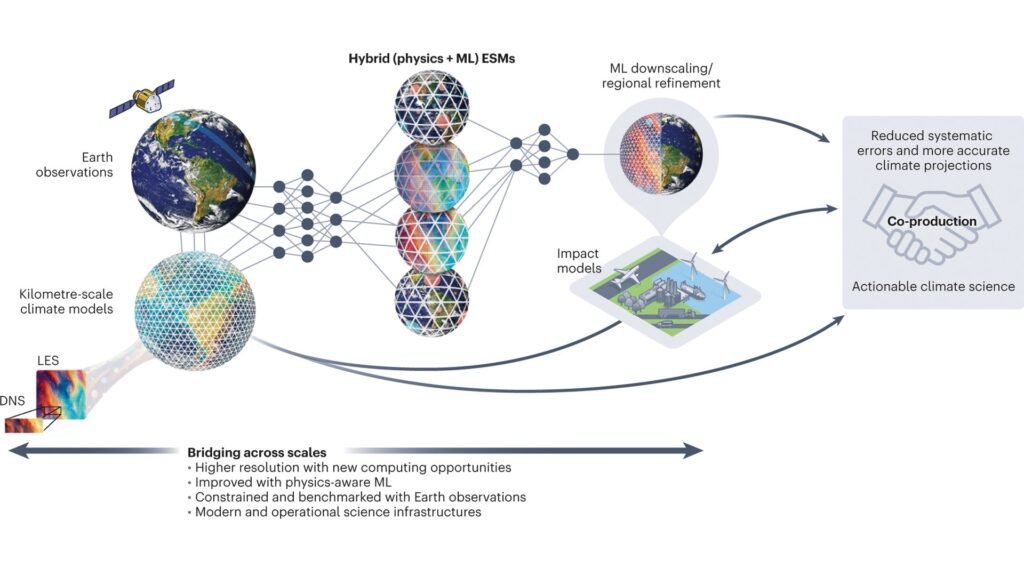
- Physics-Informed AI: Incorporating physical constraints directly into AI model architectures could help ensure that generated forecasts remain physically realistic.
- Multi-Model Ensembles: Combining multiple AI models with traditional forecasting methods could provide more robust and reliable predictions.
- Real-Time Validation: Developing systems for continuous validation of AI forecasts against real-world observations could help identify and correct biases quickly.
Conclusion
The Rice University study represents a crucial step forward in our understanding of AI weather forecasting capabilities and limitations. While AI models offer remarkable improvements in computational speed and show promising results in track forecasting, significant challenges remain in accurately predicting storm intensity and maintaining physical realism.
As these technologies continue to evolve, the research emphasizes the importance of maintaining a balanced approach that leverages the speed and efficiency of AI while preserving the physical accuracy and human expertise that are essential for reliable weather forecasting. The future of meteorology likely lies not in choosing between AI and traditional methods, but in developing sophisticated hybrid approaches that combine the best of both worlds.
For communities in hurricane-prone regions, this research provides reassurance that while AI is transforming weather forecasting, the human expertise and careful validation that have long been the foundation of meteorology will remain essential for protecting public safety.
References
Weng, Y., Gori, A., et al. (2026). Climatological Benchmarking of AI‐Generated Tropical Cyclones. Journal of Geophysical Research: Atmospheres. DOI: 10.1029/2025jd044753
Original source: https://phys.org/news/2026-03-ai-weather-hurricane-key-physical.html