AI Co-Scientist Systems Are Accelerating Scientific Discovery Across Multiple Fields
Introduction
Scientific research has entered a new era where artificial intelligence is no longer just a tool for data analysis but an active collaborator in the discovery process. Recent developments in AI technology have given rise to sophisticated multi-agent systems that can generate hypotheses, design experiments, and even propose novel research directions across multiple scientific disciplines.
This transformation is particularly evident in the development of Google’s multi-agent AI system built with Gemini 2.0, which functions as a “virtual scientific collaborator.” This system represents a fundamental shift in how scientific research is conducted, promising to accelerate breakthroughs in fields ranging from healthcare to climate science and materials discovery.
Understanding the AI Co-Scientist System
The new AI systems act as comprehensive research partners rather than simple analytical tools. These platforms employ multiple specialized agents that work together to mimic the scientific method. Each agent has specific functions, including hypothesis generation, literature synthesis, experimental design, and results analysis.
The system continuously refines its outputs through iterative feedback loops, allowing it to improve its suggestions based on new information and results. This collaborative approach enables researchers to move from initial ideas to validated discoveries much faster than traditional methods.
Revolutionizing Healthcare Research
Accelerated Drug Discovery
One of the most significant impacts of AI co-scientist systems is in pharmaceutical research. Traditional drug development typically takes 10-15 years and costs billions of dollars. AI systems can dramatically reduce this timeline by analyzing existing drugs and suggesting new therapeutic applications, a process known as drug repurposing.
Google’s AI co-scientist recently demonstrated this capability by proposing treatments for acute myeloid leukemia, with subsequent laboratory experiments validating these AI-generated suggestions. Companies like Insilico Medicine have taken this further, successfully bringing AI-discovered drugs to human trials.
Personalized Medicine Advancement
AI systems can process vast amounts of genetic and clinical data to match patients with the most effective treatments. This personalized approach is particularly transformative in cancer care, where AI helps identify optimal therapies based on individual genetic profiles. The technology enables doctors to move beyond one-size-fits-all treatments to precision medicine tailored to each patient’s unique characteristics.
Diagnostic Enhancement
AI-powered diagnostic tools analyze medical images, laboratory results, and patient histories to identify patterns that human observers might miss. These systems can detect cancer in radiology images, predict heart disease risk, and identify rare genetic disorders with accuracy that often exceeds human specialists.
Climate Research Applications
Enhanced Climate Modeling
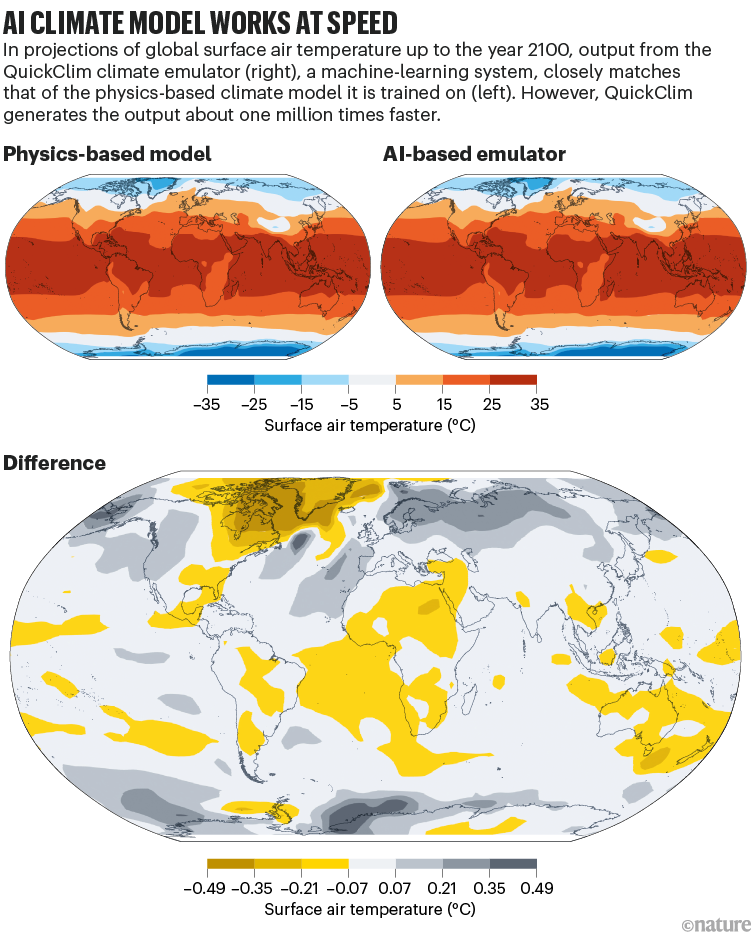
Climate science benefits enormously from AI’s ability to process complex datasets and identify patterns in atmospheric conditions. AI models can predict weather patterns, track extreme weather events, and assess the impact of human activities on climate systems with unprecedented accuracy. These predictions help governments and organizations prepare for climate-related disasters and develop effective mitigation strategies.
Environmental Monitoring
AI-powered sensors and image analysis tools monitor environmental changes in real-time, tracking deforestation, pollution levels, and wildlife populations. This continuous monitoring enables rapid responses to environmental threats and provides accurate measurements of conservation efforts’ effectiveness.
Breakthroughs in Materials Science
Accelerated Material Discovery
AI is revolutionizing materials science by enabling the discovery of new materials at an unprecedented pace. Google DeepMind’s GNoME tool identified 380,000 stable materials that could exist at low temperatures, potentially leading to advances in solar cells, batteries, and superconductors. This represents a fundamental shift from the traditional trial-and-error approach to materials research.
Quantum Computing Integration
The intersection of AI and quantum computing has produced remarkable results. Google’s Willow quantum AI chip solved complex computational problems in minutes that would require classical supercomputers septillions of years to complete. This advancement moves quantum computing closer to practical, large-scale applications that could transform multiple scientific fields.
Genomics and Space Exploration
Genetic Research Acceleration
AI processes massive genomic datasets to identify mutations linked to diseases, dramatically speeding up the development of gene therapies and precision medicine approaches. This capability has led to breakthroughs in understanding cancer, Alzheimer’s disease, and rare genetic disorders that would have taken decades using traditional methods.
Space Science Enhancement
In space exploration, AI analyzes data from telescopes and space probes to help scientists identify new planets, study cosmic phenomena, and plan missions. AI-driven simulations test hypotheses about the universe’s origins and structure, enabling discoveries that push the boundaries of human knowledge about space.
Real-World Impact and Success Stories
The practical applications of AI co-scientist systems are already demonstrating significant value. Insilico Medicine’s success in bringing AI-discovered drugs to human trials represents a major milestone in pharmaceutical research. Their drug for pulmonary fibrosis, discovered entirely by AI, entered mid-stage human trials in 2023.
Atomwise’s AtomNet platform has shown similar success, using deep learning for structure-based drug design across a library of over three trillion compounds. Their 2024 study identified novel therapeutic candidates for 235 different targets, demonstrating AI’s ability to accelerate drug discovery across multiple disease areas simultaneously.
Implications for Future Research
The emergence of AI co-scientist systems represents a fundamental shift in how scientific research is conducted. These systems enable researchers to:
- Process and synthesize vast amounts of scientific literature instantaneously
- Generate novel hypotheses that human researchers might not consider
- Design experiments that optimize for multiple variables simultaneously
- Accelerate the validation process through predictive modeling
- Collaborate across disciplines by identifying connections between seemingly unrelated fields
Challenges and Considerations
Despite the tremendous potential, several challenges must be addressed for AI co-scientist systems to reach their full potential. Data quality and privacy concerns are paramount, particularly in healthcare applications where patient information must be protected. The interpretability of AI decisions remains crucial, as scientists need to understand how AI arrives at its conclusions to trust and effectively use its recommendations.
Collaboration between AI systems and human researchers requires careful balance. AI works best as a partner to human experts rather than a replacement, requiring ongoing collaboration between AI developers, scientists, and domain specialists for optimal results.
Conclusion
The development of AI co-scientist systems marks a transformative moment in scientific research. By acting as virtual collaborators that can generate hypotheses, design experiments, and propose novel research directions, these systems are accelerating discovery across multiple fields. From drug discovery and personalized medicine to climate modeling and materials science, AI is enabling breakthroughs that would be impossible through traditional methods alone.
As these systems continue to evolve and improve, they promise to unlock new frontiers in scientific knowledge and practical applications. The integration of AI as a collaborative partner in research represents not just a technological advancement, but a fundamental shift in how humanity approaches the process of scientific discovery.
Reference
Webclues Infotech Private Limited. (2025). “AI Accelerating Scientific Breakthroughs: Revolutionizing Healthcare, Climate Research & More.” Artificial Intelligence in Plain English. Retrieved from https://ai.plainenglish.io/ai-accelerating-scientific-breakthroughs-revolutionizing-healthcare-climate-research-more-fff9e1437754